| Trouble viewing this email? Read it online. |

| February 20, 2026 | Submit a College Note |
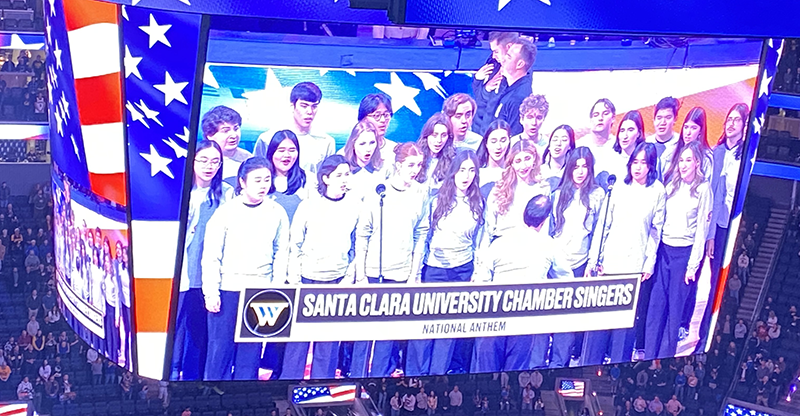 The SCU Chamber Singers, conducted by Scot Hanna-Weir (Music), performed "The Star Spangled Banner" at the Golden State Warriors game on February 11. Watch the video.
I want to give a shout out to Meaghan Deegan (Chemistry and Biochemistry) who was recently named a 2026 Cottrell Scholar by the Research Corporation for Science Advancement. The award recognizes Meaghan’s breakthrough work in organometallic chemistry and her commitment to bringing hands-on research to chemistry students at Santa Clara. As I mentioned in our announcement online, Meaghan’s ability to secure such a prestigious national award speaks to her brilliance as a researcher, while her commitment to involving our undergraduates in that discovery is what truly defines her impact on our campus. Big congratulations to Meaghan! This weekend is Family Weekend on campus! The College is participating in a number of events this year. Earlier this week, the Student Engagement Team hosted a couple webinars for parents on advising and student support as well as experiential learning opportunities. Tom Plante (Psychology) and Iris Stewart-Frey (Environmental Studies and Sciences) are participating in a panel this afternoon at 2:30 in the Music Recital Hall with faculty from Business, Engineering and the Markkula Center for Applied Ethics titled, “The Brave New World of A.I.” The panelists will share the current and future impacts of Artificial Intelligence and will discuss how technological changes could impact career paths, alter the development of industries, and affect education. Additionally, our annual Student Showcase featuring 23 students from 18 different departments will take place this evening from 5 - 6:30 p.m. in the Vari Lobby. If you’re on campus, stop by to see their exciting work! A reminder that REAL Program applications are due by March 1. If you know students who may be interested, please encourage them to attend an information session next week and apply! This week's poem is by Terrance Hayes, Professor of Creative Writing at New York University. It is about Zora Neal Hurston, the anthropologist, writer, folklorist, and filmmaker. There is a lot here – I recommend you read it twice! Daniel Zora in Beaufort, 1940
By Terrance Hayes
Highlights
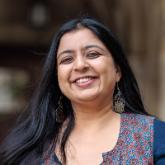
Supurna Dasgupta (English) recently published an article in Modernism/Modernity titled "The Strange Fragrance of Rice: Crisis Modernism in the Colony and the Bengal Famine." In her article, she explored how the discourse of global modernism often overlooks or neglects multiple local energies that are both politically and aesthetically motivated. Through her analysis of modernist poems composed during a devastating manmade famine in colonial South Asia, she argued that the poems embodied a blend of modernist, Marxist, anti-imperialist, and realist concerns, leading her to coin the phrase crisis modernism that can be used to evaluate similar situations in colonial and postcolonial context. 
The latest paper from Paul Gilbert's (Public Health) national study of recovery from alcohol problems has been published, reporting findings from interviews with 65 people who resolved an alcohol use disorder without treatment. This paper was prompted by the recognition that non-abstinent recovery has long been documented yet the phenomenon remains poorly understood. Paul and his research team sought to answer two questions: Why do some people chose to continue low-level drinking instead of abstaining from alcohol, and how do they continue drinking in a way consistent with recovery? They learned that people who chose non-abstinence relied on internal resources, structured their drinking, and benefited from supportive social contexts. In addition, people may change their recovery goals from abstinence to non-abstinence or vice-versa, sometimes multiple times. In this line of research, Paul and his team seek to understand recovery in all its forms and hope to expand the repertoire of supportive services for people pursuing recovery from alcohol problems.
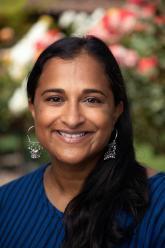
Mythri Jegathesan (Anthropology) published a commentary in Current Anthropology on Alyssa Paredes' article, "Plantation Liberalism: A Genealogy of Personhood, Property, and Environmental Litigation between Philippine Mindanao and the Black Atlantic." In the comment, Mythri used archival materials from the United States and the Philippines to engage Paredes' arguments on the racialized ideologies that inform conceptualizations of personhood and property around Mindanao's banana plantations. In doing so, she argued for scholars in global plantation studies to foreground the conditions of militarization and nationalism that inform the state's relationships to plantation markets.
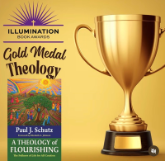
Paul Schutz's (Religious Studies) book A Theology of Flourishing has received the 2026 Gold Medal in Theology from the Illumination Awards. Since 2013, the Illumination Awards have recognized outstanding publications and creative works in Christian theology and spirituality. They recognize three books in a number of categories, giving a gold, silver, and bronze medal in each one.
tUrn13 highlighted Indigenous and Black/African-American, scholarly, creative, and moral leadership in and perspectives on the climate crisis, as well as U.N. and CA DOJ leaders. Topics of the week included architecture, colonialism & neo-colonialism, alternative economies, poetry, theatre, whales, local actions, voting, extractive industries, business school curricula, human rights, law, politics, government, religion, incarceration, food, animals, children, disinformation, ethics, AI, and divestment.
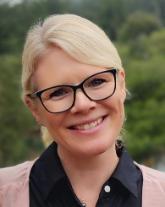
Birgit Koopmann-Holm (Psychology) was part of a large international team of researchers who conducted a meta-analysis using data from over 31,000 participants across 124 datasets collected by research teams around the world. Consistent with prior work, the researchers found that ideal affect—how people want to feel—is empirically distinct from actual affect, or how people actually feel, and that cultural differences are larger and more robust for ideal affect than for actual affect. Beyond replicating established patterns, the meta-analysis also revealed new and evolving trends in how different cultural groups value emotional states over time. Because ideal affect is closely tied to everyday life—shaping preferences for consumer products and activities, beliefs about happiness and well-being, and how people evaluate and treat others—these findings help explain meaningful variation in human behavior. Together, the results highlight the enduring role of culture in shaping emotional goals, while also pointing to important within-culture variation and change. Recognizing cultural differences in ideal affect may be critical for fostering mutual understanding, trust, and social cohesion in an increasingly multicultural and interconnected world. This article was recently published in the top-tier journal Psychological Bulletin.

Danielle Fuentes Morgan (English) was featured on NPR's All Things Considered in a segment entitled "Life, Liberty and the Very American Pursuit of Humor." She discussed the role of satire in American life and politics and its role in self-making, particularly for Black Americans.
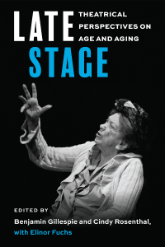
Benjamin Gillespie (Theatre and Dance) published his co-edited volume Late Stage: Theatrical Perspectives on Age and Aging (University of Michigan Press, 2026). This landmark anthology is the first comprehensive collection to bring age studies into dialogue with theatre and performance studies scholarship, challenging ageist narratives of decline and reimagining aging as a dynamic, socially shaped dimension of identity alongside gender, race, sexuality, and ability. Late Stage explores key works by canonical and contemporary playwrights from Anton Chekhov to Caryl Churchill as well as the work of iconic performers such as Isabelle Huppert, Judith Malina, and Peggy Shaw. The book serves not only as a critical text for courses on performance and age, but as a call to action for expanding conversations around aging in theatre and society. “Late Stage is an important, moving compendium of multivocal, multidisciplinary essays that ‘think age and theatre together’ in honor of the late, pioneering scholar Elinor Fuchs. Using age as a too often maligned or ignored identity vector and as a hermeneutic, these essays consider the body’s time-based materiality as a living testament to the power of performance.” - Jill Dolan, Princeton University Image: Actress Judith Malina in one of her final performances featured on the cover of Late Stage.
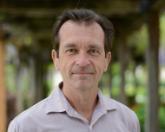
Tom Plante (Psychology) gave an invited presentation on February 4, titled "Prayer and Psychotherapy" for the Word on Fire Institute as part of a weeklong special series on spirituality and mental health care titled "Offering a Hand in the Dark."
On February 12, the French & Francophone Studies Program hosted Storytelling Behind Bars, an event celebrating the work of justice-impacted writers. Students, staff, and faculty engaged in lively conversation with Knowledge B and Ivan Kilgore, two authors who are currently incarcerated, about their writing practices and projects. They also learned from campus organizers about opportunities for student engagement and participated in a collaborative editing workshop where audience members provided creative feedback on writing submitted by an author in custody. The event was part of an ongoing initiative by the French & Francophone Studies Program to diversify the curriculum in support of underrepresented voices. This includes the ELSJ course FREN 120E: Writing Beyond Walls, to be taught for the second time by Keziah Poole (Modern Languages and Literatures) in Spring; an associated summer internship with the United Black Family Scholarship Foundation (UBFSF); and a translation project focused on French prison writing. Two students who completed the UBFSF internship with support from the REAL Program last summer, Gianna Madden ’27 (French & Francophone Studies, Management, Political Science) and Erena Daniel ’27 (Engineering Physics), helped facilitate the event and presented their collaboration on the Hundred Stories Project, an international effort to support the publication of writing by incarcerated authors.
REAL Program Information SessionsThe REAL Program is providing information sessions on the following dates: February 24, 9:30 - 10:15 a.m. (Daly Science 310) Application deadline: March 1 Faculty Development
Got IT Questions or Issues?Stop by the virtual IT drop-in sessions with Charles Deleon! These sessions are designed to provide faculty and staff in the College of Arts and Sciences a friendly and casual setting for addressing general IT questions and concerns. Feel free to drop in and out at any time during the scheduled session, whether you have a quick question, need assistance with something and don't know where to start, or simply want to learn more about our IT resources. Next session: Friday, Mar. 6, 11:30 a.m.–12:30 p.m. Zoom link Get connected!      |
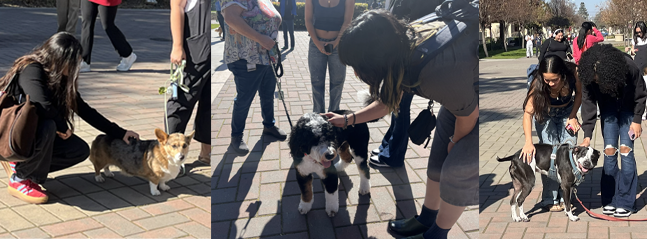 Dogs at SET's You’ve Got This - Snacks, Dogs, and Fun event on February 4.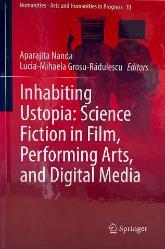
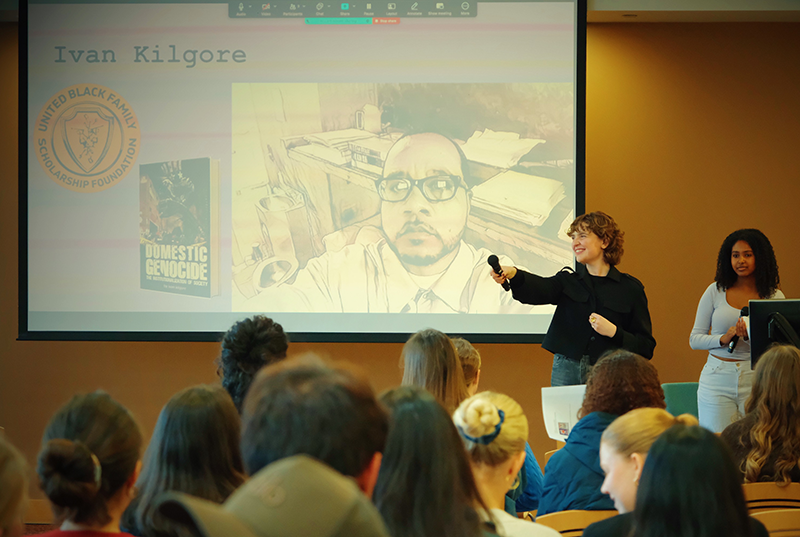 Gianna Madden holds out a microphone to capture applause for guest speaker Ivan Kilgore, an incarcerated author and founder of the United Black Family Scholarship Foundation. Photo by Gwyneth Choi ’26 (French & Francophone Studies, Sociology).
| College of Arts and Sciences |
Submit a College NoteQuestions? Contact Sandy Boyer |