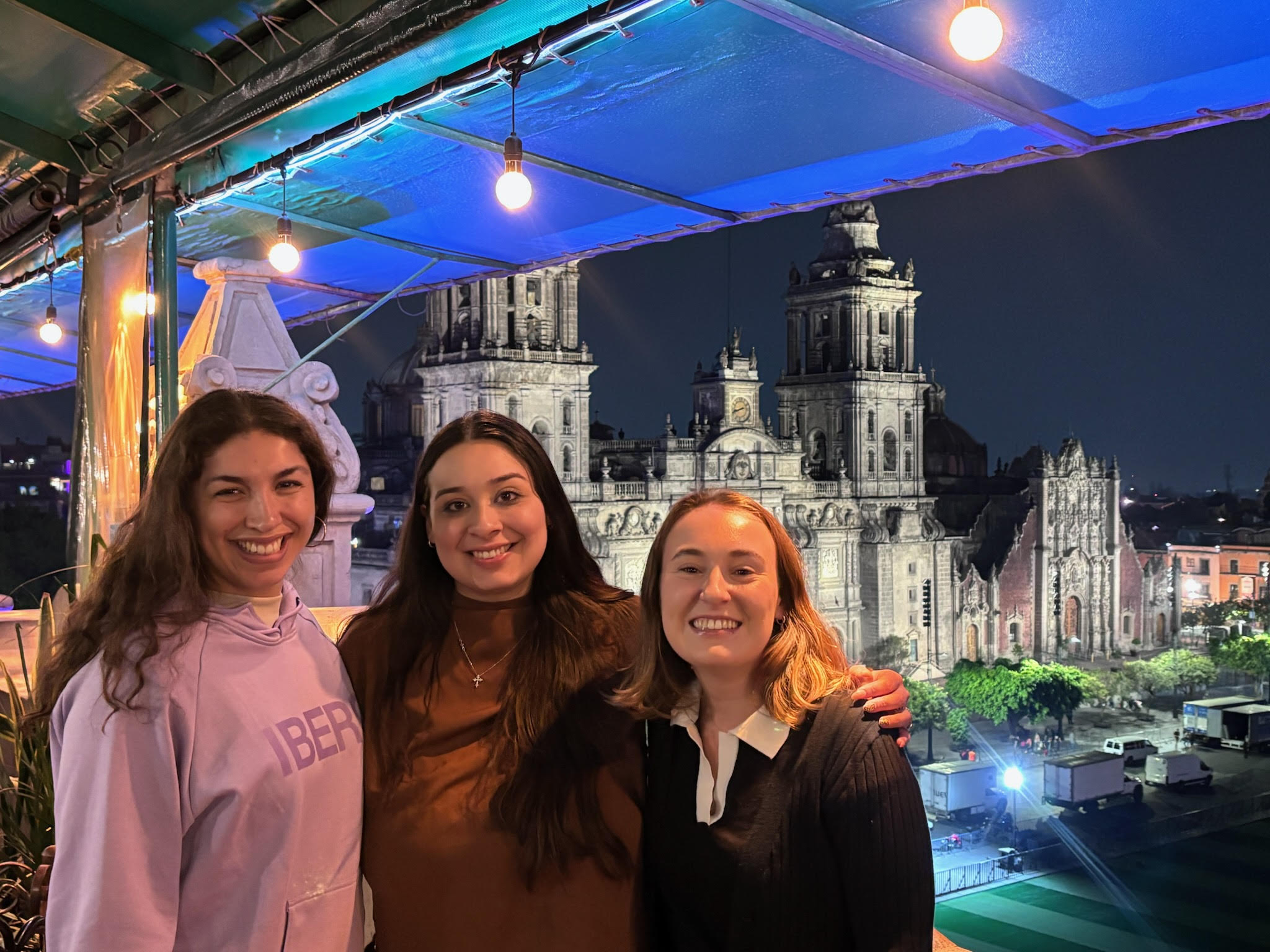
In their words: Santa Clara Law students reflect on Mexico City service trip
Introduction by Professor Evangeline Abriel
During Santa Clara Law’s Spring Break 2026, I had the enormous privilege of travelling to Mexico City with three of our amazing law students, Amanda O’Dea (3L), Natalie Granado (2L), and Rebecca Macias (2L), to spend a week working with the Alaide Foppa Refugee Law Clinic of the Universidad Iberoamericana, a sister Jesuit university. The students wrote blog posts describing the week and the effect that it had on them, and I am pleased to share the students’ moving descriptions of their experience. At the same time, many thanks are in order – to the Dachs family, who provided the funding, to Sarah Brockmeyer, Director of International Programs, who provided invaluable logistical support, to my co-director Lynette Parker for all her planning and advice; to Gam Galindo for excellent training, and to Enrique Vazquez Camacho, an Ibero student now pursuing an LL.M. degree at Santa Clara Law, who gave us an outstanding pre-trip training on Mexican refugee law. We are also indebted to the Alaide Foppa Clinic staff and students, who welcomed us with open arms.
Now to hear directly from our students.
Day 1 - Amanda O'Dea
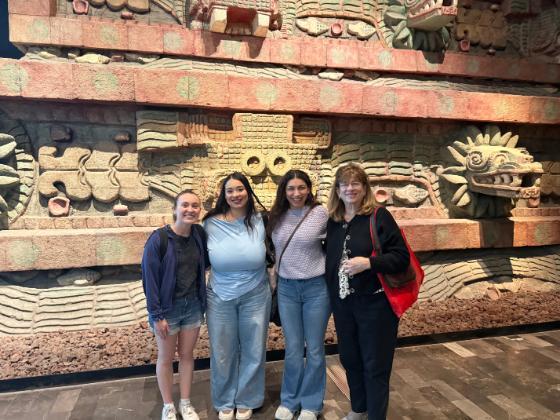
Amanda O’Dea, Natalie Granado, Rebecca Macias, Evangeline Abriel
Our first day in Mexico City was a wonderful start to the trip. We woke up early and made our way through the busy streets of the city to Universidad Iberoamericana, where we visited their legal clinic. Once we arrived, we met with the clinic’s director, Salvador Guerrero Navarro, who explained the clinic’s mission and the important work they do to support vulnerable communities.
We also had the opportunity to speak with Hydekel Rivera Diaz, a law student working at the clinic. He shared some of the cases he is currently involved in, many of which focus on helping families seek asylum in Mexico when they cannot safely return to their home countries. Hearing about these cases gave us a deeper understanding of the real-life impact of immigration law and the role legal clinics can play in protecting people in difficult circumstances. During our visit, we learned several key differences between Mexican and U.S. refugee law. Mexico uses a broader legal definition of a refugee than the United States and approves a higher percentage of asylum applications. The asylum process also differs, with Mexico focusing mainly on protection from political violence.
Legal education is different, too, and we had great fun comparing experiences. In Mexico, students begin law school right after high school. Their program is five years long, and they were surprised to hear ours is technically seven years! The students we met were incredibly welcoming and passionate about immigration work. It was inspiring to hear about their experiences and the cases they are helping with through the clinic.
By the end of the first day, I had already realized how impactful this trip would be for me. I came to law school to serve others, learn from people’s lived experiences, and make a meaningful impact. This experience has helped me reconnect with those values, and I am incredibly grateful for the opportunity. And the flan!
Day 2 - Natalie Granado
On our second day at the Ibero, we had the opportunity to work directly with the students at Clínica Jurídica Alaíde Foppa on real Mexican asylum cases. As we discussed Mexico’s asylum system, we learned that unlike in the U.S., Mexico’s asylum system is shaped not only by its own laws and constitution, but also by international treaties, such as the 1984 Cartagena Declaration, broadening the definition of who may qualify for refugee protection. This broader definition means that the challenges asylees face in Mexico are not dependent on whether or not all the elements of an asylum claim are met as it is here in the U.S., but whether they have assistance in following all of the procedural and administrative aspects of filing their claim.
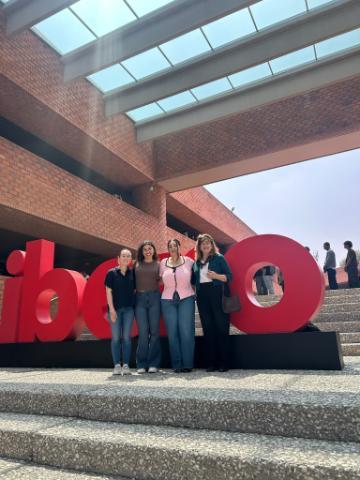
We also sat in on a real client call involving a Venezuelan man who was seeking asylum in Mexico. The students interviewing him asked him about his journey to Mexico, his life in the country, and about why he could not safely return to Venezuela. As I listened to him speak, I was reminded of the work that we do in the United States. As an immigration paralegal, I often conduct similar declaration interviews where clients recount details about their journey to the U.S. and the dangers that face them in their home country. Observing this interview in real time allowed me to appreciate both the similarities and the differences between our two asylum systems. While the barriers asylees face differ, the process of working with clients by building rapport, listening to their stories, and recording their experiences are the same across borders.
The students also gave us a brief overview of each of the cases that they were working on. One case involved a Venezuelan man who was previously a DACA recipient, but was deported and seeking refugee status in Mexico. Hearing about this case felt particularly impactful for us as students coming from the United States. This man’s case demonstrated that shifts in U.S. immigration policy can have ripple effects across borders. When someone is denied protection in the United States, neighboring countries such as Mexico are left to face the consequences.
Spending the day at Ibero was an incredible learning experience, and opened my eyes to the differences, similarities, and relationship between the U.S. and Mexican asylum systems. It was inspiring to work with the Ibero students to create a cross-border coalition focused on protecting refugees. I am deeply grateful to the donor who made this opportunity to learn from one another and reflect possible.
Day 3 - Rebecca Macias
On Wednesday morning, we had the great honor of visiting La Agencia de la ONU para los Refugiados (ACNUR), otherwise known in English as the United Nations High Commissioner for Refugees (UNHCR). UNHCR was established by the General Assembly of the United Nations in 1950 to help those who lost their homes in the aftermath of World War II. Since then, they have continued to provide life-saving assistance to refugees. ACNUR specifically works with the Mexican government and other organizations in Mexico to achieve the inclusion of the refugee population in the country. They do this by providing asylum seekers and refugees with legal assistance and with information about their rights, among other things.
Three main things stuck out to me about our visit to ACNUR.
First was the incredibly beautiful mural that was right outside of their office. It immediately caught my attention. It was painted by Mexican artist Amauri Esmarq, and it depicted a person’s journey from their home country to Mexico when they must flee due to persecution. The mural begins with a man and a woman walking in the middle of the jungle; the man carries a single backpack and the woman looks exhausted. It then continues, showing a father carrying his child; others crossing the river on makeshift boats or walking across the water with their belongings held above their head; a child, smiling, in the arms of an ACNUR worker; two men embracing; a person guiding another; and then finally, a family, happy and in a new home, playing soccer.
The second thing that stuck out to me was a second piece of art. This one was inside ACNUR’s office, and it was a child’s drawing depicting the journey to Mexico. The journey, marked by footprints, begins with fear – it depicts characters yelling angrily at the child, scenes of violence and even death, a jail. But then the scene turns into a community – a school, a hospital, a church, kids playing soccer. There are peace signs and a rainbow. These pieces of art stuck out to me because they not only depict the true amount of courage one has when searching for a new life, but because they also depict the difference we as advocates and as social justice organizations can make when we choose to fight against systems meant to demean human beings. By simply being kind to people who are fleeing their homes and refusing to be complacent with these draconian systems and policies, we can restore a person’s humanity.
The third thing that stuck out to me during our visit with ACNUR were the two representatives with whom met: Guillermo and Ana. Guillermo and Ana had an amazing presentation ready for us. They provided us with information about their efforts to support asylum seekers and refugees in Mexico and the obstacles they run into. But the presentation, as incredible and informative as it was, wasn’t the main thing that grabbed my attention. It was Guillermo and Ana themselves. They were heroes.
I couldn’t stop pinching myself that I was there, in a real UN office. It was so surreal. For the longest time, working at the UN or being at the UN felt only like a dream, something I could never reach, something too big to go after. But being there, I couldn’t stop thinking, “I’m here. This is real. There are real people doing this work, and I am talking to two of them right now.” It was like a dream come true. Something that for the longest time was so out of reach, finally felt within my grasp. It felt like we could be part of the work, too, to serve refugees and migrants. I was so inspired by Ana and Guillermo to hear about the work that they do and just awestruck by being in the same room with them.
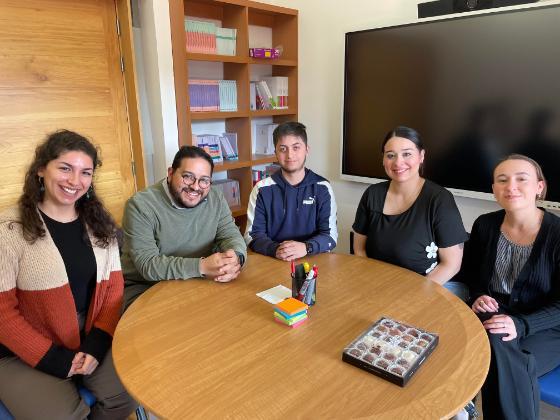
After our visit at ACNUR, we then went back to Ibero to have lunch with the clinical students and the directors of the Ibero’s law school clinics. It was incredible to be there and talk to all of them, especially the students. We didn’t just talk about school or the cases they were working on; we talked about everything. We talked about their classes and our classes, the differences and similarities between going to school in Mexico versus going to school in the U.S., and they gave us a bunch of recommendations of things to do while in Mexico City. It was such an amazing cultural exchange – getting to know each other and creating camaraderie with each other.
Everyone we came across on Wednesday, from Ana and Guillermo at ACNUR to the students and professors from Ibero, told us, “If you need help with any of your cases, please do not hesitate to reach out to us.” And we told them the same thing. It was kind of funny – like we were creating a (not-so-secret) network of vigilantes. That no matter what policies are put into place on either side of the border, no matter what obstacles we run into, we’re going to continue to fight, and we won’t stop fighting. It was as though we were declaring: “We are here. And we will never stop fighting.”
I left on Wednesday feeling completely in awe and blessed and grateful to be there. To be here at Santa Clara Law. To be in a position where one day, hopefully, we can make a difference.
Not all heroes wear capes. Some wear a blue lanyard with the words Naciones Unidas on them, just like Ana and Guillermo did. Others wear a blue shirt with the letters “UNHCR/ACNUR” stitched across, like the woman in Amauri Esmarq’s mural did. Others are still students, working in these clinics to raise their voice for those who don’t have one. And still others, arguably the most heroic ones, are the ones we don’t often notice. The ones we overlook as a society. The ones who sacrifice everything and put their faith and hope in a dream that they will one day have a better life elsewhere. The ones who pack everything they own into a single backpack and travel thousands of miles to an unfamiliar country. The ones who carry their kids when their kids can’t go on, even when they themselves are exhausted. The ones who keep on going and don’t give up even when the systems that we put into place want to bring them down.
It’s for these heroes that the rest of us do this work.
It's for these heroes that we declare, “Estamos aquí. Y nunca dejaremos de luchar.”
Day 4 - Professor Evangeline Abriel
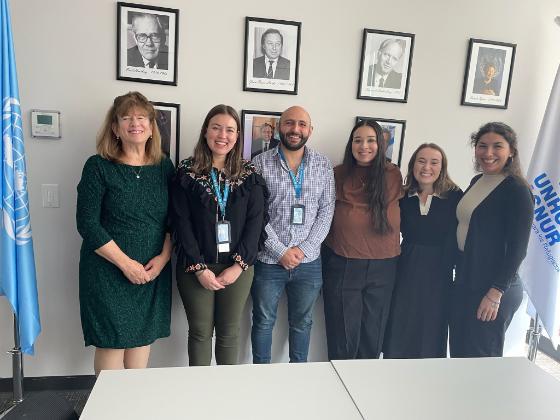
Evangeline Abriel, Guillermo E. Díaz Ordaz Rigada, Natalie Granado, Amanda O’Dea, Rebecca Macias
Thursday, March 12, 2026, the fourth day of our visit, was a remarkable one. We spent the morning working with Alaide Foppa Clinic students drafting opening documents in amparo cases. Amparo is a sort of writ, developed in Mexico, blending habeas corpus, mandamus, and general assertions of violations of human rights. The cases were ones in which asylum applicants were appealing denials of their claims by COMAR, the Comision Mexicana de Ayuda a Refugiados. Our students were also able to sit in with the Alaide Foppa Clinic students on their phone meetings with their clients.
This working together was so moving for me to see. I had just completed teaching a course to our international LL.M. and exchange students at Santa Clara Law, in which three international students, including Enrique Vazquez Camacho of the Ibero, wrote a brief to the Board of Immigration Appeals, representing a client seeking asylum in the United States. Now I was able to see our Santa Clara Law students in Mexico, working on cases of people seeking asylum in Mexico. I am overwhelmed by the skill and dedication of these law students of both nationalities working on both sides of the border to support refugees.
In the afternoon, we attended a clinic class at which representatives of Doctors Without Borders spoke movingly about the agency’s important work with asylum seekers in Mexico.
Probably the highlight of the trip for all of us was a very impactful visit to the Casa Tochan refugee shelter. There, we met with four people - from Mexico, Nicaragua, Honduras, and Afghanistan. Each had a question about U.S. immigration law, and we were able to provide some information and orientation. For example, the man from Afghanistan has a brother detained by ICE in the United States and wanted to ask how he might arrange for the brother to come to Mexico instead of being deported to Afghanistan. The visit to the shelter and the consultations we were able to provide gave us a very visceral understanding of the impact U.S. immigration law and policies have on individuals and on Mexico, which receives people we have deported.
This trip has had an enormous impact on my understanding of regional and Mexican immigration law and the things we can learn about the U.S. asylum system. For example, I was not aware of the extent to which amparo is used in seeking review of asylum denials. In addition, I learned that Mexico employs not only the international definition of refugee from the 1951 U.N. Convention on the Status of Refugees, which the United States also applies, but also a much-expanded definition of refugee from the Organization of American States' Cartagena Declaration. As a result, Mexico's asylum grant rate is much higher than that of the United States. While I was familiar with the Cartagena Declaration prior to this trip, I had not realized the breadth of its application in Mexico and the impact that it has on Mexican asylum applications. I also became aware of the extent to which Mexican lawyers and courts rely not only on domestic law, but on Mexico’s obligations under international conventions.
One other wonderful part of this trip was the relationship forged between our students and the Ibero Clinic students as they worked together on cases and compared their law school experiences. At the end of the day, our students and the Alaide Foppa students hugged, took photos, and exchanged contact information, demonstrating the lasting effect of the week spent together.
Rebecca Macias, Amanda O’Dea, Natalie Granado